ISO 14001 — Environmental Management
Environmental aspects, lifecycle thinking and legal-compliance tracking that stand up to regulators and customer sustainability audits.
ISO 14001 is the international standard, published by the International Organization for Standardization (ISO), that specifies requirements for an environmental management system. It gives organizations of any size and sector a framework to control their environmental aspects, meet their compliance obligations and improve environmental performance. The current edition, ISO 14001:2026, was published in April 2026.
Many certified organizations are still on ISO 14001:2015, and those certificates remain valid during a 36-month transition that ends in 2029. If you are starting a project now, ask your certification body which edition it can audit you against, and plan the transition as part of your certification cycle rather than as a separate project.
For a Canadian business, ISO 14001 answers questions from customers running supplier sustainability programs, tenders that ask about environmental management, and the regulators who issue your permits.
What the ISO 14001 engagement covers
Every ISO 14001 project runs on the same hybrid model: the compliance management software holds and tracks the system, and a certified lead consultant reviews the work and stands with you through the certification audit. The core elements below are tailored to how your operation actually runs.
Aspects & Impacts
Legal Compliance
Emergency Preparedness
How the software supports ISO 14001
ISO 14001 is in the catalogue. Clause status, evidence links and the statement of applicability live in the Standards workspace, and audits, corrective actions and training records come from the same modules used for ISO 9001, so one system carries both.
Every ISO 14001 clause sits in the Standards workspace with a status (Compliant, Partial, Review overdue or No evidence), coverage against a target, linked evidence, and a statement of applicability export.
How we get you certified
Gap Analysis
Weeks 1–2A structured assessment of your current operations against the target standard. Every clause scored, every gap mapped to an owner and a due date.
System Design
Weeks 2–5A compliance management system designed around how your business runs. Processes are mapped with owners in Processes, and clauses are marked in or out of scope in the Standards workspace, not copied from a template.
Documentation
Weeks 4–9Procedures, work instructions and records drafted in Documents, with optional AI drafting and consultant review. Lean documentation your team will use.
Implementation
Weeks 8–16Roll-out with training campaigns, competency records and evidence capture. My actions and the daily summary show who still owes what, so nothing slips before the audit.
Internal Audit
Weeks 14–18A full internal audit in the Audits workspace and a management review that surface findings early. Corrective actions are closed in Improvements before the certification body arrives.
Certification
Weeks 18–24Stage 1 and Stage 2 audit support with your registrar. We are in the room, and we stay on for surveillance-audit readiness.
What does ISO 14001 require?
ISO 14001 does not set emission limits or performance targets. It requires a system that finds what your operation does to the environment, decides what matters most, and keeps those activities under control. The clause numbers below are from ISO 14001:2015, the edition many current certificates are held against.
The core of the system is the link between significant aspects, compliance obligations and operational controls. An auditor will pick a significant aspect, such as solvent use or wastewater discharge, and expect to follow it to the legal requirement, the control, the monitoring record and the person responsible.
Context and scope (clause 4)
You define the boundaries of the system and the internal and external issues, including environmental conditions, that affect what the system must achieve.
Environmental aspects (clause 6.1.2)
You identify the aspects of your activities, products and services that you can control or influence, consider a life cycle perspective, and determine which aspects are significant.
Compliance obligations (clause 6.1.3)
You identify the legal requirements and other commitments that relate to your aspects, keep access to them, and determine how each one applies to the organization.
Operational control (clause 8.1)
You set operating criteria for processes linked to significant aspects, control or influence outsourced processes, and consider environmental requirements in design and purchasing.
Emergency preparedness and response (clause 8.2)
You plan responses to potential emergencies such as spills or uncontrolled releases, test them periodically where practicable, and review them after a test or a real event.
Evaluation of compliance (clause 9.1.2)
You check at a planned frequency whether each compliance obligation is being met, act on any gap, and keep documented evidence of the results.
Who needs ISO 14001 certification in Canada?
ISO 14001 certification is voluntary. The demand comes from buyers, from project owners and from the practical need to manage environmental legal obligations in one place.
Supply chains are a frequent trigger. Automotive suppliers meet environmental management requirements in customer supplier manuals, construction and fabrication firms meet them in prequalification for public projects, and mining and resource operations face scrutiny from communities, investors and permitting authorities. In each case, a certificate from an accredited body is a recognized way to show that environmental risk is managed rather than left to chance.
The compliance side is where the system earns its place. A plant in Ontario may answer to federal law such as the Canadian Environmental Protection Act, 1999, to provincial law such as Ontario's Environmental Protection Act, to the conditions of an Environmental Compliance Approval or an Environmental Activity and Sector Registry registration, and to municipal sewer-use bylaws. ISO 14001 requires those obligations to be identified, kept current and evaluated, but certification never replaces them.
How long does ISO 14001 certification take, and what drives the cost?
For a single-site manufacturer, a first ISO 14001 certification typically takes four to eight months. A company that already runs ISO 9001 can often move faster, because document control, internal audit, corrective action and management review can serve both standards from one set of procedures.
Much of the effort sits in two places. The first is building an accurate register of environmental aspects and compliance obligations, which takes longer for sites with air emissions, process wastewater, hazardous waste or stored chemicals. The second is producing records that show the controls work, such as waste manifests, monitoring results, inspection logs and spill drill reports.
The number of sites in scope and the state of existing permits and monitoring programs also move the timeline. Certification body fees are quoted in audit days, which depend on headcount and environmental complexity.
A free readiness check gives you a scored starting point against the standard.
Preparing for the ISO 14001 certification audit
The certification audit runs in two stages. Stage 1 reviews your documented system: scope, environmental policy, the aspects register, the compliance obligations register and your readiness for Stage 2. Stage 2 tests whether the system works on the floor, which is where gaps in day-to-day practice show up.
Expect the auditor to walk the site. Chemical storage, spill kits, waste areas, drains and air emission points are compared against what the aspects register says, and operators are asked what they would do in a spill. The evaluation of compliance gets close attention, because a system that has never checked its own permit conditions is hard to defend.
Choose a certification body accredited for ISO 14001, either by the Standards Council of Canada or by another accreditation body that is a signatory to the International Accreditation Forum (IAF) Multilateral Recognition Arrangement. Confirm which edition it will audit against and how it is handling the transition to ISO 14001:2026.
Complete at least one internal audit and a management review before Stage 1, and close the corrective actions they raise. The six-stage certification process shows how ISO Certification Consultants sequence that work.
ISO 14001 questions, answered
Is ISO 14001 certification mandatory in Canada?
No. ISO 14001 certification is voluntary in Canada. Companies pursue it because customers, project owners and tenders ask for evidence of environmental management, and because it gives a structured way to track environmental legal obligations. Federal, provincial and municipal environmental laws apply whether or not you are certified, and the certificate does not replace any permit or approval.
Should a new project certify to ISO 14001:2015 or ISO 14001:2026?
ISO 14001:2026 was published in April 2026, and ISO 14001:2015 certificates remain valid during a 36-month transition ending in 2029. The practical answer depends on your certification body, so ask when it can issue certificates to the 2026 edition. Starting on the current edition avoids a second transition audit within the first certification cycle, which is worth discussing before you set the audit date.
Does ISO 14001 certification prove a company complies with environmental law?
Not on its own. ISO 14001 requires a commitment to fulfill compliance obligations and a documented evaluation of compliance, and the certification auditor samples that evidence. An auditor is not a regulator, however, and does not inspect every permit condition. Certification shows that a working system exists for finding and meeting legal requirements, which is valuable, but legal compliance remains a separate responsibility.
Can ISO 14001 be combined with ISO 9001 and ISO 45001?
Yes. ISO management system standards share a common high-level structure, so policy, objectives, document control, internal audit, corrective action and management review can be run once for all three. Many organizations build an integrated system with ISO 45001 for health and safety and ISO 9001 for quality, then schedule combined audits with one certification body to reduce disruption.
What is an environmental aspect?
An environmental aspect is an element of your activities, products or services that interacts, or can interact, with the environment. A compressor that can leak oil, a paint line that emits solvents, and scrap sent to landfill are all aspects. The change they cause, such as soil contamination or air pollution, is the environmental impact. ISO 14001 requires you to identify aspects and decide which are significant.
Articles on ISO 14001
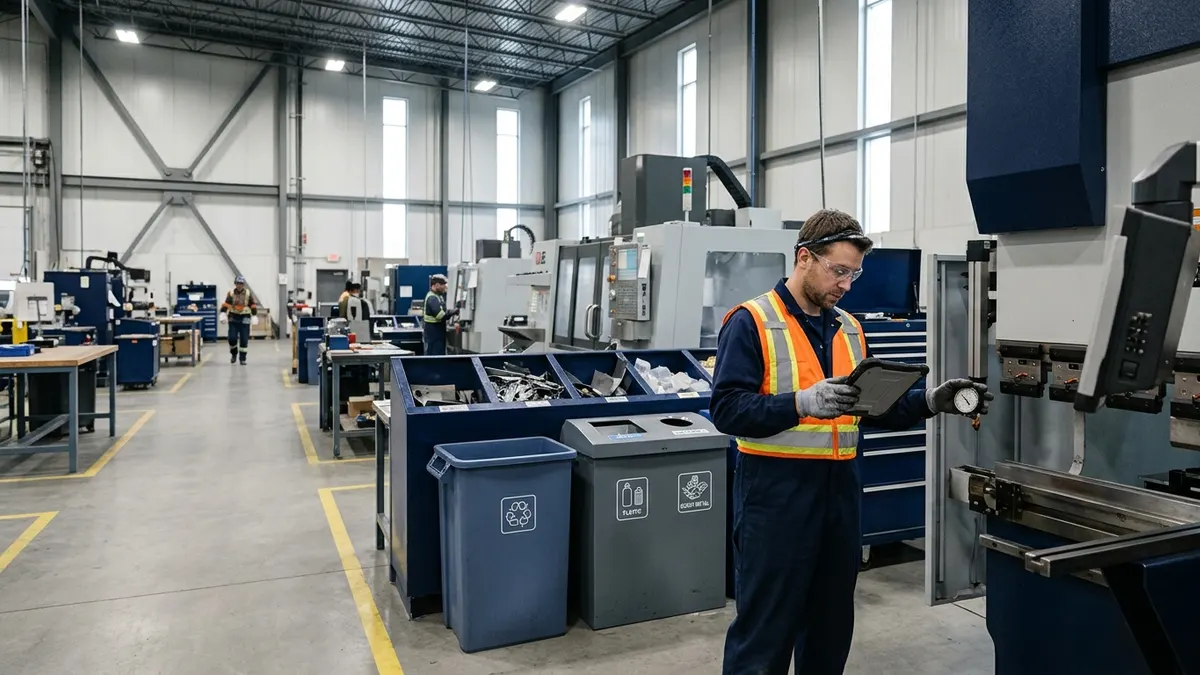
10-Point ISO 14001 Requirements Checklist for Manufacturing Operations
Evaluate your plant with this 10-point ISO 14001 requirements checklist. Verify aspects, legal compliance, and operational controls before your audit.
·9 min read

Navigating ISO 14001 Compliance Obligations in Canada: The Plant Manager's Playbook
Master ISO 14001 compliance obligations in Canada. Learn how Ontario industrial facilities identify legal requirements, track updates, and satisfy Clause 6.1.3.
·11 min read

How to Build an ISO 14001 Environmental Aspects and Impacts Register in 6 Steps
Build a compliant ISO 14001 environmental aspects and impacts register with this 6-step practical method designed for Ontario manufacturing facilities.
·10 min read
Explore other standards
Ready to scope your ISO 14001 certification?
Tell us about your operation and what you're certifying for. You'll get a clear, honest read on scope and timeline from a certified lead consultant.
We reply within one business day