
Key Takeaways
- An aspects and impacts register is the document that drives the rest of an environmental management system: it decides which controls, objectives and monitoring a plant needs.
- Clause 6.1.2 of ISO 14001:2015 asks for a life-cycle view, scored significance and documented results, and auditors test all three.
- Build the register in order: map processes, list aspects, tie each to an impact, score with fixed criteria, attach controls, then review it on a schedule.
- A register that lists aspects but never links significant ones to controls is the gap auditors find most often.
A plant gets asked for an ISO 14001 environmental aspects and impacts register long before anyone has decided what belongs in it. The request usually arrives from a customer questionnaire, a registrar's Stage 1 checklist or an internal push toward certification. The result is often a spreadsheet of fifty lines that nobody can defend when an auditor asks why a particular line was scored the way it was.
This guide walks through six steps that produce a register a plant manager can explain and an auditor can trace. ISO 14001:2026 is the current edition, and many certified organizations are still on the 2015 edition during the transition, so the clause references below name ISO 14001:2015 and describe requirements in plain words.
Understanding Aspects vs Impacts Under Clause 6.1.2
An environmental aspect is something the organization does, makes or uses that can interact with the environment. An environmental impact is the change that results, good or bad. Diesel burned in a forklift is an aspect; the air emission it creates is the impact.

Clause 6.1.2 of ISO 14001:2015 asks the organization to determine its aspects and related impacts within the scope of the system, taking a life-cycle perspective. It must also consider change, abnormal operating conditions and emergency situations, decide which aspects are significant, and keep documented information on all of it. Those four requirements are the skeleton of the register.
Did You Know? ISO 14001:2015 does not prescribe a register format. It requires documented information on aspects, impacts, the criteria used and the significant aspects, so a single table with a few extra columns can satisfy all four.
Step 1: Map Manufacturing Processes and Life-Cycle Stages
What to do. Draw each process in the plant from incoming material through shipping, then add the stages just outside the fence: raw material supply, transport, product use and end-of-life handling. A simple flow for each department is enough. The point is that nothing gets listed in the register that cannot be located on a map.
What you need. Process owners from production, maintenance, shipping and the tool crib, plus a current site layout. Include non-routine activities such as tank cleaning, shutdown maintenance and commissioning of new equipment.
The common mistake. Mapping only the production line. Boiler rooms, compressors, wastewater pre-treatment, parts washers and waste storage areas often carry the heaviest environmental load, and they are the first places an auditor walks to.
Step 2: Identify Direct and Indirect Environmental Aspects
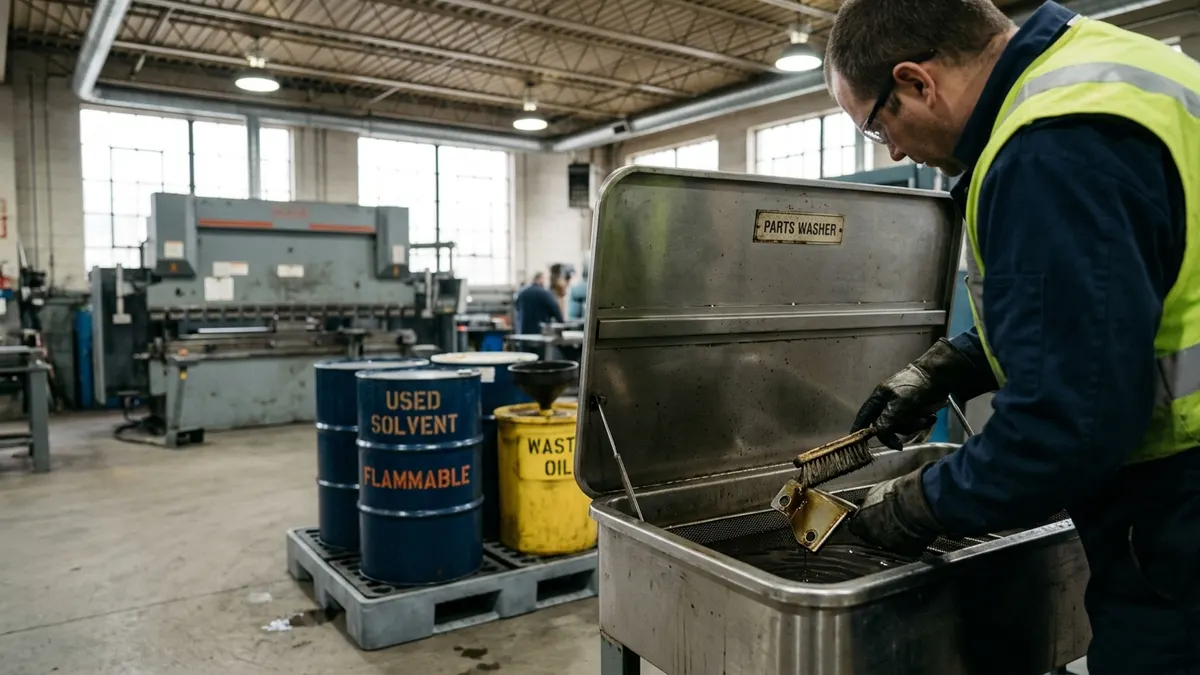
What to do. Walk each mapped step and write down what it uses and releases. Direct aspects are activities the plant controls itself, such as coolant use, compressed air, paint overspray and scrap metal. Indirect aspects are ones the plant influences but does not control, such as a supplier's packaging choices, a carrier's fleet or how customers dispose of the finished product.
A short prompt list keeps the walk consistent:
- Inputs: energy, water, raw materials, chemicals and packaging each get a line, because consumption is an aspect in its own right.
- Outputs: air emissions, wastewater, solid and hazardous waste, noise, odor and heat should be checked at every step.
- Non-normal conditions: spills, fires, power failures and equipment breakdowns belong in the register as abnormal or emergency aspects.
What you need. Safety data sheets, waste manifests, utility bills and the plant's Ontario environmental compliance approvals where emissions, discharges or waste activities are approved. Those documents show what the site already reports to regulators.
The common mistake. Ignoring indirect aspects because they feel out of reach. The standard asks the organization to consider what it can influence, not only what it directly runs, so a documented judgment on each indirect aspect is expected even when the answer is "low influence."
Step 3: Connect Concrete Environmental Impacts to Each Aspect
What to do. For every aspect, name the specific change in the environment. "Waste" is not an impact. "Hazardous waste sent to landfill reduces landfill capacity and risks soil and groundwater contamination if mishandled" is. Write one aspect per row and one or more impacts beside it.
What you need. The aspect list from Step 2, plus input from whoever handles environmental permits, since permit conditions often describe the impact in the regulator's own words.
The common mistake. Copying generic impact wording across rows. When every line says "pollution of air," the register tells an auditor nothing about the site, and it becomes hard to score one aspect against another.
Key Consideration: Write impacts in terms a new supervisor would understand. If the wording only makes sense to the person who wrote it, the register will not hold up during an audit interview.
Step 4: Establish Objective Significance Scoring Criteria
What to do. Decide how the plant will judge significance before scoring a single line. Criteria need to be written down, applied the same way to every aspect and easy to repeat. A common approach is to score each aspect on a few factors and add a rule that certain conditions make an aspect significant automatically.
These factors typically fall into two groups:
- Environmental factors: severity of the impact, scale of the quantity involved, how often it occurs and how likely an abnormal event is.
- Business and legal factors: whether a legal requirement applies, whether a permit limit is involved, and how interested parties such as neighbors, customers or regulators view the issue.
Compliance obligations should override the arithmetic. An aspect governed by the Ontario Environmental Protection Act or reportable under the National Pollutant Release Inventory should be treated as significant by rule, rather than depending on whether its numeric score crosses a line.
What you need. A scoring scale with written definitions for each level, the legal register, and a short calibration session where two or three people score the same five aspects independently and compare.
The common mistake. Scoring by instinct. If two assessors would score the same aspect differently, the criteria are too vague, and an auditor who re-scores a few lines will find the gap quickly.
Illustrative example: A stamping plant scores its coolant mist, scrap steel and electricity use. Electricity scores high on scale but low on severity, while coolant mist triggers a legal-requirement rule because of a workplace air quality limit. The written criteria produce a defensible result for both without anyone arguing about it.
Step 5: Link Significant Aspects to Operational Controls
What to do. Take every significant aspect and trace it to something the plant actually does about it. Clause 6.1.4 of ISO 14001:2015 asks for actions to address significant aspects, clause 6.2 links them to objectives, and clause 8.1 requires operational controls. A useful register therefore carries three extra columns: the control (procedure, work instruction, equipment or training), the objective if one applies, and the person responsible.
What you need. Existing procedures for waste handling, spill response and chemical storage, the objectives list, and the maintenance schedule for pollution control equipment.
The common mistake. Leaving the register disconnected from the rest of the system. When a significant aspect has no control and no objective beside it, the register looks like an exercise instead of the starting point of the system, and a significant aspect without a control is one of the quickest ways to a nonconformance.
Linking works in both directions. If an operational procedure exists for a process that never appears as significant in the register, either the procedure is unnecessary or the scoring missed something. Both outcomes are worth discussing.
Step 6: Maintain and Update the Register for Management Review
What to do. Assign an owner, set a review interval and decide what triggers an early update. Typical triggers are a new product, a new chemical, a process change, an incident, a change in law and a supplier change. Record each revision with a date and a short description.
What you need. A change-management route that tells the environmental lead about new equipment or materials before they arrive, and a standing item in management review. Clause 9.3 of ISO 14001:2015 expects top management to look at changes in aspects and the system's performance.
The common mistake. Treating the register as an annual file. A register that was last updated before a new paint line was installed will fail its first surveillance audit, because the new line's aspects are missing.
Important: Certification bodies expect the register to reflect the plant as it operates today. Reviewing it only before an audit is easy to spot, because revision dates cluster in the weeks before the visit.
For plants in the sector, the manufacturing industry page describes how these requirements apply across typical production environments, and the ISO 14001 Environmental Management service page explains what the full system covers.
Frequently Asked Questions
What is the difference between an environmental aspect and an environmental impact?
An aspect is the activity, product or service that interacts with the environment, such as using solvent in a parts washer. The impact is the resulting change, such as air emissions or contaminated waste. The register records both and links them row by row.
How often should an ISO 14001 environmental aspects and impacts register be updated?
The standard does not set a fixed interval. A sound approach is a scheduled review at least once a year plus an immediate update whenever a process, material, building, legal requirement or incident changes the picture. The review should feed into management review.
What criteria determine whether an environmental aspect is considered significant?
The organization chooses its own criteria, but they must be documented and applied consistently. Severity, scale, frequency, probability, legal requirements and interested-party concern are common choices. Many plants also add a rule that any aspect tied to a permit limit is significant by default.
Are manufacturers required to evaluate indirect environmental aspects under ISO 14001?
Yes, to the extent the organization can control or influence them. Suppliers, contractors, transport and product end-of-life all deserve a recorded judgment, even if the conclusion is that influence is limited and no action follows.
What common mistakes do ISO auditors find in environmental aspects registers?
Frequent findings include missing abnormal and emergency conditions, vague impacts, scoring that cannot be reproduced, significant aspects with no linked control, and registers that were not updated after a process change. Each one traces back to a step above.
Putting the Register to Work
A register built in this order stays useful because every column leads somewhere: to a control, an objective, a person and a review date. Plants that want a second opinion before a registrar sees the document can start with the free ISO readiness assessment, or talk through scoring criteria and control linkage with a consultant through the contact page.