
Key Takeaways
- An ISO 9001 internal audit checklist works best when it follows how product moves through the plant, not the order of the standard.
- Clause 9.2 of ISO 9001:2015 requires audits at planned intervals, objective auditors and records of results, so the checklist must produce evidence, not opinions.
- Twelve checkpoints cover the clauses that registrars most often probe: context, leadership, planning, people, records, orders, design, suppliers, production, release, nonconformances and review.
- Every finding needs a corrective action that is verified later, not just closed on paper.
An ISO 9001 internal audit checklist is only useful if the person holding it knows what a good answer looks like. A list of clause titles with tick boxes produces a tidy form and an unprepared plant. A list of questions tied to real records produces findings that make the next registrar visit uneventful.
ISO 9001:2026 is the current edition of the standard, published in September 2026. Many certified plants are still working to ISO 9001:2015 during the three-year transition, so the clause numbers below refer to the 2015 edition. The twelve points follow the flow of a typical machining, stamping or fabrication operation, from the contract to the management review.
Each point names what to ask, what evidence to pull and what usually goes wrong. Clause 9.2 of ISO 9001:2015 sets the frame: the audit program is planned, the auditors are objective and impartial, and results are reported to the relevant managers. The auditing guidelines in ISO 19011:2026 describe how to run that program, and the checklist below fits inside it.
1. Context of the Organization and Scope Verification (Clause 4)
Start with the scope statement, because every other answer depends on it. Ask where the quality management system applies, which products and sites it covers and whether any requirement is claimed as not applicable.
Compare the written scope with what the plant actually makes. A common finding is a scope that still lists a product line that was discontinued, or leaves out a new line that now ships to customers.
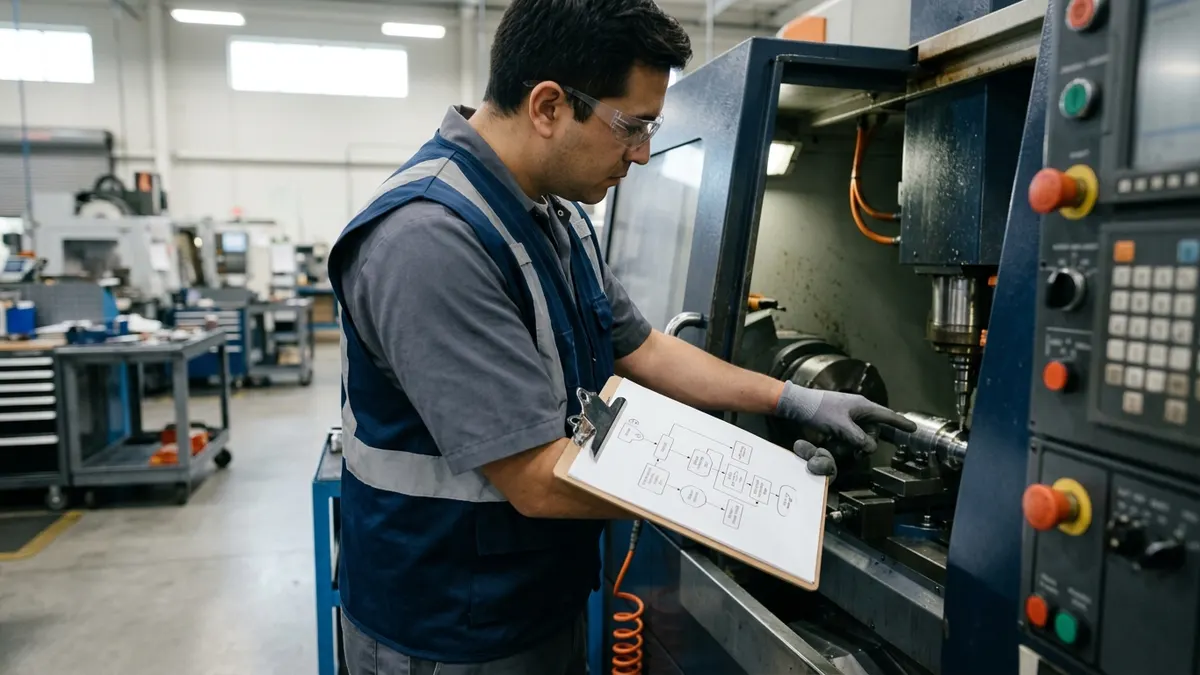
Evidence to pull: the scope statement, the list of interested parties and the process interaction map. Check that the processes on the map exist in daily work, with owners who can name them.
2. Leadership Commitment and Quality Policy Alignment (Clause 5)
Interview the plant manager or owner, not only the quality manager. Ask how the quality policy connects to what the plant is trying to achieve this year, and where the policy is posted and communicated.
An auditor listens for whether leadership can describe the policy in their own words. A policy that only exists as a framed page by the front door suggests the commitment is thin.
- Confirm that roles, responsibilities and authorities are assigned and that people in those roles know it.
- Check that the policy is available to interested parties where appropriate and understood by operators on the floor.
3. Risk-Based Thinking and Quality Objectives Tracking (Clause 6)
Ask for the register of risks and opportunities and for the quality objectives, then ask who last looked at them. Objectives should be measurable, tied to the policy and reviewed against results, not set once and forgotten.
An objective with no owner, no target and no review date is a finding. Trace one objective, such as on-time delivery or scrap rate, from the target to the monthly numbers to the action taken when the number missed.
Key Consideration: Pick objectives the plant already measures. An audit goes faster, and the answers are more honest, when the data comes from the shop floor rather than a new spreadsheet built for the audit.
4. Personnel Competence and Training Verification (Clause 7.2)
Choose three roles that affect product quality, such as a press operator, an inspector and a welder. For each, ask what the job requires, how competence was confirmed and where the record sits.
Look at the gap between the training matrix and the person standing at the machine. Training records that show a course date but no evidence the person can do the task are a frequent weak spot.
5. Documented Information and Revision Controls (Clause 7.5)
Walk to a workstation and check that the work instruction, drawing or inspection plan in use is the current revision. This takes two minutes and finds more problems than reading the procedure on document control.
Then check how records are kept, protected and retained. Obsolete documents at the point of use are one of the most common internal audit findings, and they often trace to a missing step in the engineering change process.
Did You Know? Clause 7.5 of ISO 9001:2015 does not set a fixed list of required procedures. It requires the documented information the standard calls for, plus whatever the organization decides it needs for the system to work.
6. Customer Requirements and Order Review Controls (Clause 8.2)
Pull a recent purchase order and follow it. Ask how the plant confirmed it could meet the requirements before accepting it, including delivery dates, special characteristics and any customer-specific flow-down.
Check that changes to an order, such as a revised quantity or drawing, were communicated to the people who build it.
- Verify that the review record shows who reviewed the order and what was confirmed.
- Look for a documented way to handle customer property and customer feedback, including complaints.
7. Design and Development Verification Controls (Clause 8.3)
If the plant designs products or tooling, ask how design inputs are captured and how outputs are verified and validated. Plants that only build to print may justify excluding this clause, but the exclusion must be explained in the scope.
Look at one design change from start to finish. The auditor wants to see planned stages, reviews with the right people, and evidence that the change was verified before release to production.
8. External Provider Evaluation and Receiving Inspection (Clause 8.4)
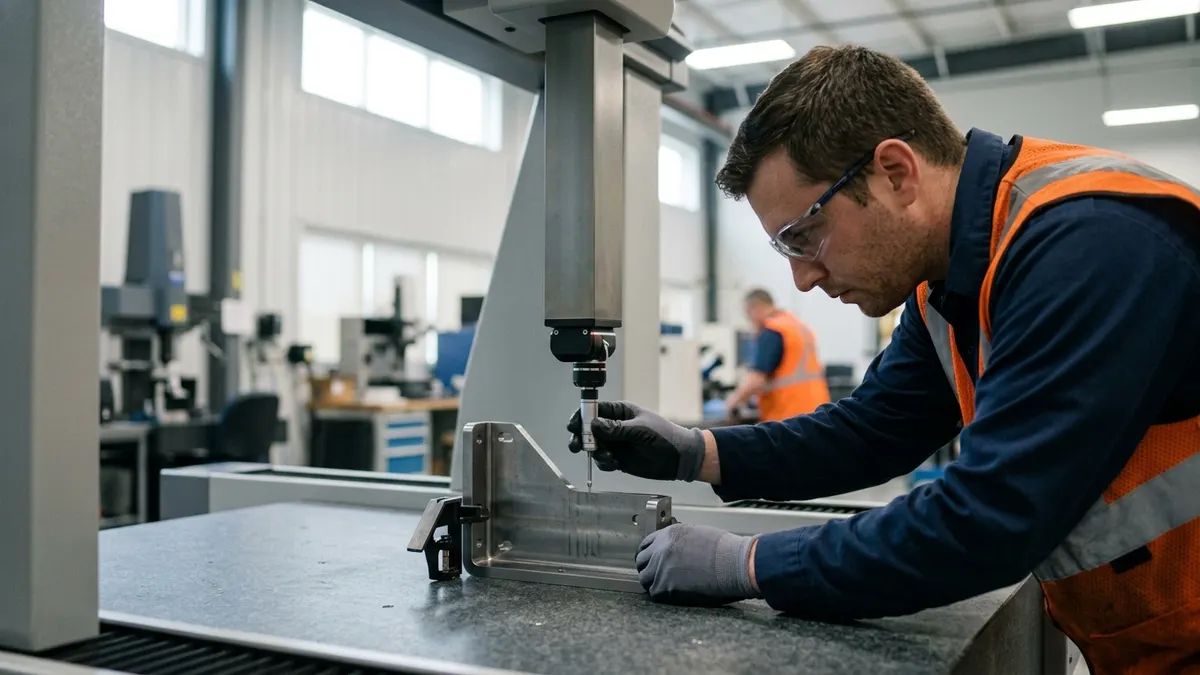
Ask how suppliers are approved, how they are monitored and what happens when one performs poorly. The approved supplier list should match what purchasing actually buys.
Check receiving inspection against the purchase order. For suppliers that claim a certificate, a plant can confirm validity through the IAF CertSearch database, which lists accredited management system certificates. A supplier's certificate is evidence, not a substitute for monitoring their delivered quality.
9. Production Control, Traceability, and Preservation (Clause 8.5)
Spend time on the floor here. Ask operators to show the instruction for the job in front of them, the gauges they are using and the calibration status of each gauge.
Test traceability by picking a finished lot and tracing it backward to the material heat or lot number. Then check how product is identified, handled and protected until it ships.
- Confirm that monitoring and measuring equipment is calibrated to traceable standards and tagged with its status.
- Check that product in storage is identified and protected from damage, corrosion and mix-ups.
10. In-Process Inspection and Product Release Authorization (Clause 8.6)
Ask who may release product and what must be true before they do. Look for evidence that planned inspection happened for the lot, signed or recorded by the person authorized to release it.
Release records should show the acceptance criteria and the result. An auditor picks a shipment from last week and confirms that every required check on the control plan was done before it left the dock.
11. Nonconforming Output Segregation and Disposition (Clause 8.7)
Find the red-tag area or hold cage and look inside. Product in it should be identified, segregated and have a status, and nothing should be there without a record explaining why.
Follow one nonconformance report from discovery to closure. Check who decided the disposition, whether the customer was notified when required and whether the corrective action addressed the cause rather than the symptom. A corrective action is only closed when someone verifies that it worked, ideally weeks later, by checking whether the problem has returned.
Important: Clause 10.2 of ISO 9001:2015 requires the organization to evaluate whether similar nonconformities exist elsewhere, and to review the effectiveness of any corrective action taken.
12. Management Review Inputs and Continual Improvement (Clauses 9.3 & 10)
Ask for the last management review minutes and compare them with the required inputs: audit results, customer feedback, process performance, status of corrective actions, supplier performance and risks. Missing inputs show up quickly when the meeting record is read line by line.
The outputs matter as much as the inputs. Look for decisions, owners and dates, and then confirm that at least one of those decisions was acted on by the next meeting.
Quick-Reference Summary
Use this table as a one-page prompt while auditing. Each row names the clause, the evidence to pull and the single most common finding.
| Point | Clause (2015 ed.) | Pull this evidence | Common finding |
|---|---|---|---|
| 1 | 4 | Scope, process map | Scope out of date |
| 2 | 5 | Policy, role assignments | Policy not understood |
| 3 | 6 | Risk register, objectives | No owner or review |
| 4 | 7.2 | Training matrix, records | Course, not competence |
| 5 | 7.5 | Work instructions | Obsolete revision in use |
| 6 | 8.2 | Order review records | Changes not passed on |
| 7 | 8.3 | Design review records | Verification not shown |
| 8 | 8.4 | Supplier list, receiving | Monitoring missing |
| 9 | 8.5 | Traceability, gauges | Calibration lapsed |
| 10 | 8.6 | Release records | Checks not recorded |
| 11 | 8.7 | NCR files, hold area | Cause not addressed |
| 12 | 9.3, 10 | Review minutes | Missing inputs |
Frequently Asked Questions
How often must a manufacturing company conduct an ISO 9001 internal audit?
Clause 9.2 of ISO 9001:2015 requires audits at planned intervals, without fixing a number. Many plants audit every process at least once a year, and audit higher-risk or problem areas more often.
Can an internal auditor audit their own department under ISO 9001?
No. The standard requires auditors to be objective and impartial, so a person should not audit their own work. Smaller shops often solve this by having the quality manager audit production and a production lead audit quality.
What qualifications are required to perform an ISO 9001 internal audit?
The standard names no certificate. It asks for competent auditors, which usually means training in audit technique, knowledge of the standard and an understanding of the process being audited.
What documents should an auditor review before beginning the internal audit?
Start with the previous audit report, open corrective actions, the process map and the audit plan. Read the procedures and records for the processes in scope so the questions on the day are specific.
How should minor nonconformances identified during an internal audit be resolved?
Record each one, correct the immediate problem and find the cause. Then decide whether further action is needed and check later that the fix held.
From Checklist to Audit-Ready Plant
The twelve points above work best when the same person does not write and answer them. A plant new to internal auditing can start with a free ISO readiness assessment to see which clauses need attention first, and read about the ISO 9001 quality management service to see how audits fit into the wider system. Plants that want an outside view of their audit program, or a manufacturing-focused consultant to run the first cycle alongside the team, can book a consultation with ISO Certification Consultants.